
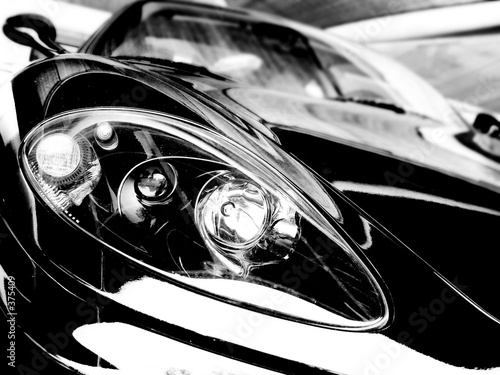


2011 Bugatti Veyron 16.4 Super Sport
At full throttle, it uses more than 125 L/100 km (2.1 mpg), which would empty its 100 L (26.4 gallon) fuel tank in just 12.5 minutes. The car’s everyday top speed is listed at 375 km/h (233 mph). When the car reaches 220 km/h (137 mph), hydraulics lower the car until it has a ground clearance of about 8.9 cm (3½ inches). At the same time, the wing and spoiler deploy. This is the “handling mode”, in which the wing helps provide 3425 newtons (770 pounds) of downforce, holding the car to the road. The driver must, using a special key (the “Top Speed Key”), toggle the lock to the left of his seat in order to attain the maximum (average) speed of 408 km/h (254 mph). The key functions only when the vehicle is at a stop when a checklist then establishes whether the car—and its driver—are ready to enable ‘top speed’ mode. If all systems are go, the rear spoiler retracts, the front air diffusers close and the ground clearance, normally 12.5 cm (4.9 inches), drops to 6.5 cm (2.6 inches).
 bugatti veyron aerodynamics
 bugatti veyron aerodynamics
 bugatti veyron aerodynamics
 bugatti veyron aerodynamics
 bugatti veyron aerodynamics
 bugatti veyron aerodynamics
 bugatti veyron aerodynamics
 bugatti veyron aerodynamics
 bugatti veyron aerodynamics
The Veyron’s brakes use unique cross-drilled and turbine-vented carbon rotors which draw in cooling air to reduce fade. Each caliper has eight titanium pistons. Bugatti claims maximum deceleration of 1.3 g on road tires. Prototypes have been subjected to repeated 1.0 g braking from 194 to 50 mph (312 to 80 km/h) without fade. With the car’s fearsome acceleration from 50 to 194 mph (80 to 312 km/h), that test can be performed every 22 seconds. At speeds above 124 mph (200 km/h), the rear wing also acts as an airbrake, snapping to a 55-degree angle in 0.4 seconds once brakes are applied, providing 0.68 g (4.9 m/s²) of deceleration (equivalent to the stopping power of an ordinary hatchback). Bugatti claims the Veyron will brake from 400 km/h (249 mph) to a standstill in less than 10 seconds. The braking is also so evenly applied that the car will not deviate from a straight path if the driver lets go of the steering wheel, even with the brakes fully applied starting from close to top speed.
 bugatti veyron aerodynamics

